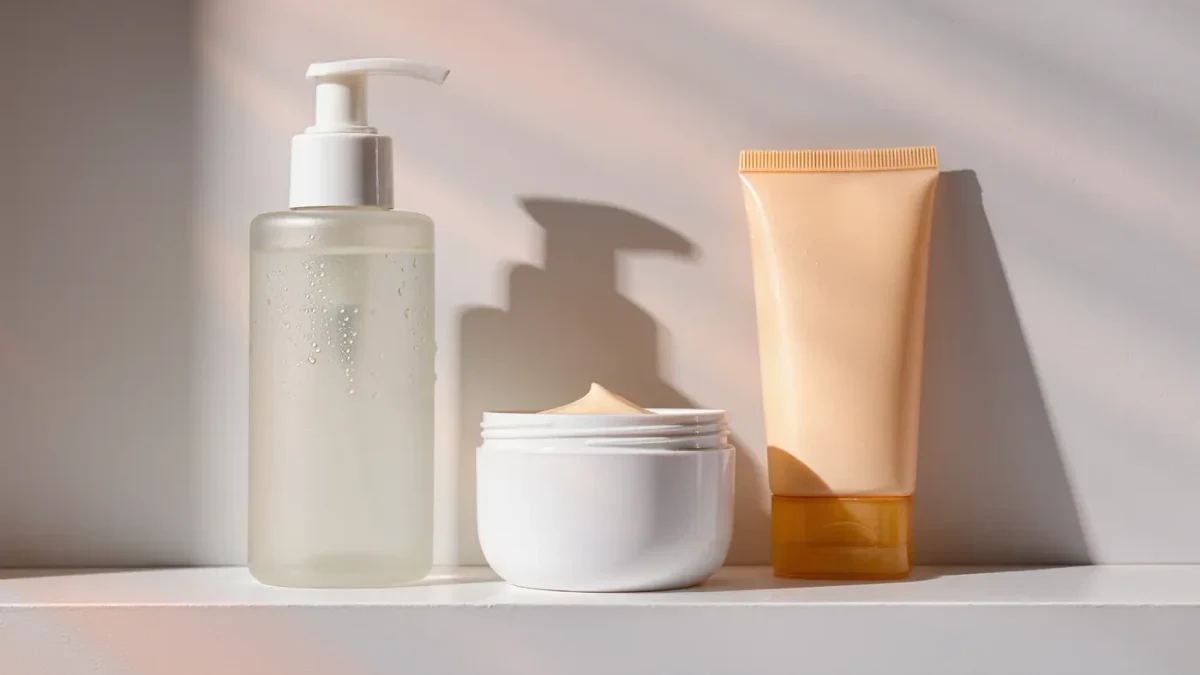
A minimalist skincare routine needs exactly three products: a gentle cleanser, a moisturizer matched to your skin type, and a broad-spectrum SPF 30 or higher every morning. That trio covers the four functions dermatologists treat as essential — removing soil and excess oil, holding water in the barrier, protecting from ultraviolet damage, and keeping the skin's pH stable. Sunscreen is the step with the strongest evidence in all of skincare: regular use of broad-spectrum SPF 30 or above has been shown in randomized trials, including a widely cited 2013 Australian study published in the Annals of Internal Medicine, to reduce skin aging over four and a half years. Everything else you add is optional and should justify itself.
This article publishes information, not medical advice. Persistent acne, rosacea, or unexplained irritation are reasons to see a board-certified dermatologist rather than to rearrange a routine on your own.
Why does a minimalist routine work at all?
It works because skin performs most of its own maintenance, and products assist rather than replace that machinery. The barrier renews itself roughly every four weeks; your job is to keep it clean, hydrated, and unsunburned so it can. Overloading a barrier with seven actives competes for the same receptors and increases irritation risk without raising returns — and irritation itself degrades the barrier you were trying to improve.
The hidden cost of a crowded shelf
Every additional product adds two variables: its own ingredients and the interactions between formulas. A twelve-step routine with three new launches in a month gives you no way to identify which product caused a reaction. Dermatologists who treat contact reactions routinely ask patients to stop everything and reintroduce one item at a time — a reset that a three-step routine never needs.
What are the three essential steps, exactly?
The essentials are cleansing, moisturizing, and sun protection, in that order morning and evening — minus the cleanser in the morning if your skin runs dry, when a water rinse suffices. Choose each product by function, not by claims, and let the ingredient list decide.
- Cleanser: a pH-balanced, non-stripping gel or cream wash; if your face feels tight afterward, the formula is too harsh.
- Moisturizer: occlusive enough for your skin type — gel-cream for oily, cream for dry — with humectants like glycerin or hyaluronic acid in the first half of the ingredient list.
- Sunscreen: broad-spectrum SPF 30 minimum, applied as a final step at roughly a nickel-sized dose for the face, reapplied during sustained outdoor exposure.
What one active is worth adding first?
If your skin tolerates everything and you want a single addition, sunscreen-adjacent evidence makes vitamin A derivatives (retinoids) the most studied cosmetic active for fine lines and tone, with vitamin C serums as the runner-up for morning antioxidant support. Add one, not both, and give it eight to twelve weeks before judging. A fifth product — a targeted treatment for acne or pigmentation — comes only when a specific concern demands it.
| Step | Morning | Evening |
|---|---|---|
| Cleanse | Water rinse or gentle cleanser | Gentle cleanser |
| Treat (optional) | Vitamin C serum | Retinoid, 2–3 nights weekly |
| Moisturize | Light lotion or gel-cream | Richer cream |
| Protect | SPF 30+, final step | — |
That is the entire architecture. Four rows, and two of the cells are optional.
Related stories: How to Treat Melasma: What Dermatologists Actually Recommend · How to Read an INCI List on Skincare Packaging Without Guessing.
How do you add a new product without wrecking the routine?
Add one product at a time and hold it there for at least four weeks — a full skin turnover cycle — before adding another. This one-in rule is the single discipline that separates people who know their skin from people who perpetually troubleshoot it. Patch-test new products on the inner forearm or behind the ear for several days first, a caveat the American Academy of Dermatology's patient materials repeat for sensitive skin.
- Identify one specific goal: fewer breakouts, softer texture, less redness at the cheeks.
- Choose a single product aimed at that goal, with its active named in the ingredient list.
- Run it two or three times weekly for two weeks, watching for stinging or new flaking.
- If the skin stays calm for a month, the product earns permanent status; if not, it leaves.
Is a 10-step routine ever better than three steps?
More steps help in specific situations — treating diagnosed acne, pigmentation disorders, or clinically dry skin under medical supervision — but the marginal gain shrinks with each addition, while the irritation risk compounds. For most people without a diagnosed condition, published comparisons of simple versus elaborate regimens show the simple ones maintain hydration and barrier function just as well. A long routine is a hobby, and hobbies are fine; it is not a higher standard of care.
What about double cleansing, essences, and face mists?
Double cleansing helps on heavy-makeup or waterproof-SPF days, when an oil-based first wash dissolves films a water-based cleanser misses — on bare-skin evenings it is redundant. Essences are lightweight hydrating layers; pleasant, not necessary. Face mists feel good and do little once evaporated unless followed by moisturizer. None of these replaces the core three, and each is a luxury purchase rather than a need.
The study didn't measure shelf clutter, but the logic of controlled experiments applies at home: one variable at a time, or you learn nothing.
How do you match a minimalist routine to your skin type?
Adjust texture and frequency, not step count. Oily skin wants a foaming or gel cleanser and a lightweight lotion, and can usually tolerate a nightly cleanser. Dry skin prefers a cream cleanser — or water alone in the morning — under a richer cream. Sensitive skin adds a constraint: fragrance-free everything, and a patch-test habit. Combination skin simply uses the dry-skin routine on dry zones and lighter textures on the T-zone; two moisturizers is a legitimate minimalist answer.
How much should a three-step routine cost?
A competent minimalist routine is one of the cheapest versions of skincare there is: drugstore cleansers and moisturizers run roughly $8 to $20 each at 2025 U.S. retail prices, and adequate SPF products start near $10. What the price buys at the high end is texture, fragrance, and packaging more than function, per side-by-side ingredient-list comparisons this site has reviewed. Spending $60 well on three products beats spending $300 on nine.
When should you add a fourth product — or stop entirely?
Add a fourth product when a specific, defined concern survives eight weeks of the core routine: stubborn breakouts point to benzoyl peroxide or adapalene, dull texture to a retinoid, visible sun spots to azelaic acid or a dermatologist visit. Stop adding — and consider a full reset — the moment any product causes stinging, new redness, or flaking, because a reacting barrier absorbs everything worse. The routine that ends the year smaller than it started is a success story, not a failure.