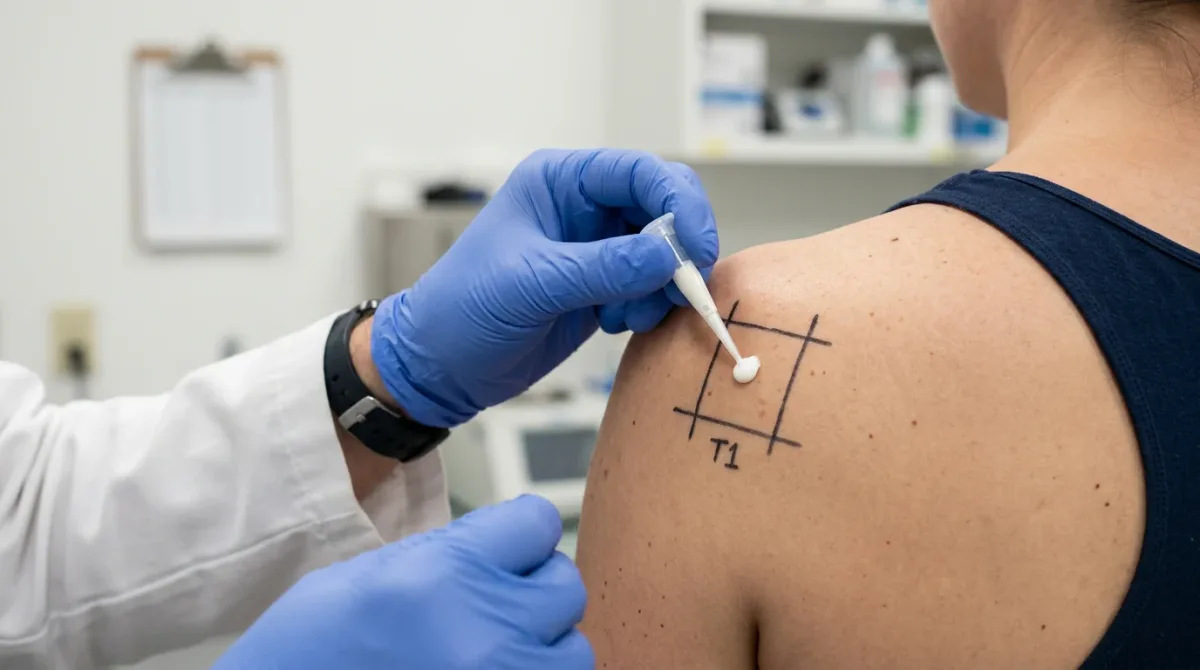
Every sunscreen bottle carries a number that sounds like a lab reading: SPF 30, SPF 50, SPF 70. Almost none of that number is generated by a machine reading a formula's chemistry. Most of it comes from a controlled sunburn on a stranger's back.
Here's what actually happens between a lab and that number on the shelf, and why two "SPF 50" sunscreens can leave your skin feeling like they're not doing the same job.
What does the SPF number actually measure?
SPF is a ratio, not an absolute score. Under the U.S. Food and Drug Administration's testing rule for over-the-counter sunscreens, a lab compares how much simulated sunlight it takes to produce the faintest sunburn (called the minimal erythemal dose, or MED) on sunscreen-protected skin versus on bare skin, according to the FDA's compliance guide for sunscreen testing (SRC-01). If it takes 30 times more UV to redden protected skin than bare skin, the product tests as SPF 30.
An independent photobiology testing lab describes the same math more simply: SPF equals the MED of treated skin divided by the MED of untreated skin (SRC-02). That's it — the number is a multiplier on how long your own skin can tolerate UV exposure before burning, not a percentage of "blockage."
How does a lab test SPF on human skin?
Under FDA protocol, testing requires a minimum of 10 valid human subjects, with up to three allowed to be rejected from the panel for inconsistent results (SRC-01). A technician applies the sunscreen at a fixed, closely measured dose — 2 milligrams per square centimeter of skin, spread with a gloved finger — to a marked patch on the subject's back, then waits at least 15 minutes before exposure begins.
That dose matters more than most people realize: it's roughly a nickel-sized amount for the face alone, and far more than most people actually apply. Testing labs describe using a similar international standard, ISO 24444, which typically calls for a panel of 10 to 20 subjects selected by an objective skin-tone measurement so results aren't skewed toward one skin type (SRC-02).
Subjects are then exposed to graduated doses of UV from a solar simulator — a lamp engineered to mimic the UVA and UVB mix of real sunlight — on both treated and untreated skin sites. After a 16- to 24-hour waiting period, trained evaluators examine each site for the first sign of redness to pin down the MED, and the SPF is calculated from there (SRC-02).
What's the difference between SPF testing and broad-spectrum testing?
The SPF number itself only reflects protection against UVB, the wavelengths most responsible for sunburn. Whether a sunscreen can also call itself "broad spectrum" — meaning it meaningfully blocks UVA, the wavelengths linked to deeper skin damage — is checked separately, and not on skin at all.
That test is done in vitro, using a spectrophotometer to measure how much UV a thin film of the product absorbs across wavelengths. To qualify as broad spectrum under FDA rules, a product's "critical wavelength" — the point where a set percentage of its total UV absorption has occurred — has to fall at 370 nanometers or higher (SRC-01). A product can pass its SPF test on human skin and still fail broad-spectrum status on the bench, or vice versa; they're two separate pass/fail hurdles bundled into one label.
Why do two "SPF 50" sunscreens feel so different?
Because the test measures burn resistance at one fixed, heavy application amount, not how the product performs at whatever thickness someone actually smooths on, or how it holds up through sweat, swimming, or a few hours outdoors. A formula's texture, how evenly someone can spread it, and how much of it rubs off are all real-world variables the SPF number was never designed to capture — the lab result assumes near-perfect, uniform application.
Are there known problems with how SPF is tested?
Yes, and researchers studying the method have flagged them directly. Vipul Bansal, a professor at RMIT University who has researched alternatives to current sunscreen testing, has said the human-panel approach carries real variability: differing skin tones among test subjects affect results, and reading erythema by eye leaves room for interpretation rather than a hard, objective cutoff. Bansal's research group is among those investigating human-free testing methods, partly because deliberately sunburning volunteers to calibrate a product also raises its own ethical questions.
None of that means the number on the bottle is meaningless — it's still the most standardized, regulator-checked figure a sunscreen carries. It just means the SPF on the label describes a controlled lab scenario on someone else's back, not a guarantee of how the product will behave on your face in real sun. That gap between lab conditions and daily wear is exactly why dermatologists tend to recommend reapplying more often, and more generously, than the number alone would suggest.
For a related beauty news perspective, read What the SPF Number on Your Sunscreen Label Actually Means.