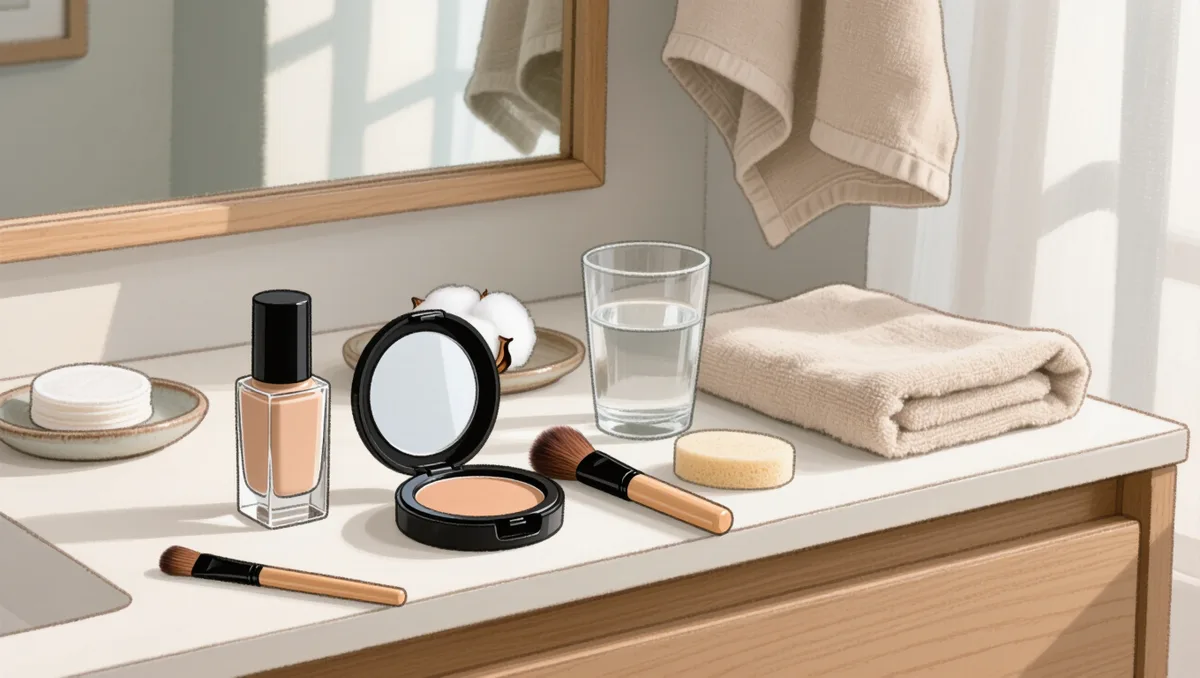
A small-space makeup vanity can work well with three things: one good light source, one mirror placed at the right height, and storage that keeps daily products within arm's reach. You do not need a dedicated room or a full dressing table. A corner, a wall shelf, or the top of a narrow console can hold a complete setup.
The main mistake people make is buying furniture first. Light and layout matter more. Get those right, and even a two-foot stretch of wall becomes a makeup vanity you can actually use every morning. Get them wrong, and no amount of storage fixes it.
This guide walks through lighting, mirrors, and storage separately, then puts them together in a few layouts for tight rooms. If you want the technique side of the routine itself, our makeup hub covers application guides in depth.
What kind of lighting does a small vanity need?
Neutral, even light wins in a small space. Aim for a bulb color temperature in the neutral range — roughly 4000 to 5000 Kelvin, described on packaging as "daylight" or "neutral white" — so foundation shades read true. Warm household bulbs pull yellow, and cool office-style bulbs pull blue. Both skew how concealer and foundation look on your face.
Placement matters as much as color. A light source in front of your face, at mirror height, shows your skin the way a window would. Overhead ceiling light casts shadows under the eyes and chin, which makes blending harder than it needs to be. In a small room, a slim LED strip or a plug-in bar mounted above or beside the mirror solves this without eating floor space.
Daylight is still the gold standard for checking a finished face. If your corner sits near a window, position the mirror so you can turn toward the glass for a final check. Just avoid direct sun on your work surface; it heats products and can degrade formulas over time.
Which mirror works best in a tight corner?
A wall-mounted mirror saves more space than any tabletop option. Mount it at the height where your eyes sit when seated or standing — whichever posture you actually use. A swing-arm mirror gives you flexibility: pull it close for detail work, push it back to see the whole face.
Magnification is a tool, not a default. A standard flat mirror shows overall balance; a magnified section helps with liner and mascara. Many wall mirrors combine both, with a small magnified spot on one side. If you wear glasses or struggle with close-up focus, test the magnification level before committing — too much magnification shows texture you would otherwise ignore, which can push you toward over-powdering.
One honest note on size: a mirror that is too small forces you to lean and turn, and that shows up in your blending. If you can only fit one mirror, choose the largest one your wall allows rather than the prettiest compact option.
How should you store makeup in a small space?
Store by frequency, not by category. Daily products go in the top drawer or the front row of an organizer. Occasional items — glitter, dramatic lashes, backup products — go higher, deeper, or out of sight. This one rule does more for a small vanity than any storage purchase.
Acrylic organizers with divided compartments work well because you can see everything at once. Drawer dividers do the same job inside a closed drawer. For very tight setups, vertical storage earns its keep: a slim cart on wheels slides beside a desk, and a wall shelf above the mirror holds palettes flat in a stack.
Keep the surface itself nearly empty. A small tray for the three or four products you use every day, plus your brush cup, is enough. Everything else lives in drawers or on shelves. A cluttered surface slows you down and collects dust on open powders.
Brush care belongs in the layout too. Dirty brushes affect both application and skin, and dermatologists' guidance on cleaning frequency is worth building into your routine — our guide to how to clean makeup brushes covers the schedule in detail. Leave an inch or two of free surface so you have a clean spot to lay brushes while they dry.
What are some layouts that fit a small room?
Three layouts cover most small spaces. Pick the one that matches what you have.
- The wall corner. A floating shelf or narrow console (18 to 24 inches deep) holds the mirror on the wall above it. A two-drawer unit or stacked organizer boxes sit underneath or beside. Lighting comes from a plug-in bar mounted on the wall. This is the most common setup and the easiest to reverse.
- The desk share. If your vanity must share a desk, use a large tray or lidded box that lifts out in one motion. A tabletop mirror with a built-in light stores flat inside a drawer between sessions. The tray keeps products from migrating across your workspace.
- The vertical column. For genuinely tiny rooms, think upward: a tall slim cart or ladder shelf holds all storage, and the mirror mounts on the wall at standing height. You apply makeup standing, which some people prefer anyway for checking the full look.
In every layout, the same principle holds: light in front of the face, mirror at eye height, storage sorted by frequency of use.
What should sit on the vanity itself?
Stock the station with the products your daily routine actually touches, and keep backups elsewhere. A typical daily lineup includes primer, base, concealer, one cheek product, one eye product, and a lip item. Retail listings make the point well: the makeup category on Amazon runs from single items under $10 to palettes and sets well past $50, so a starter vanity does not require a large spend — a few drugstore staples cover the daily slots while you work out what you reach for most.
Removal supplies deserve a spot too. Micellar water, cleansing wipes, and cotton pads stored at the vanity make it easy to take makeup off at the end of the day instead of skipping it. The same shelf logic applies: keep them visible, or they will not get used.
For the order of what goes on the skin itself — skincare, SPF, primer, then base — our explainer on the right makeup sequence breaks down why the order matters, and it pairs well with a vanity organized in the same top-to-bottom flow. Readers following this should also see Makeup Order, Explained: Skincare, SPF, Primer, Foundation — the Right Sequence.
What this means for your setup
Our analysis of what makes small vanities succeed comes down to restraint. One neutral light source. One properly placed mirror. Storage sorted by how often you reach for something. Everything else is decoration, and decoration can come later once the routine works.
Start with the lighting fix, because it is usually the cheapest change and the one with the biggest visible payoff. Then correct the mirror height. Then buy storage last, sized to the products you actually own rather than the collection you imagine. A small vanity built this way works every morning without a fight.
If your setup also serves photo days — content creation, video calls, events — lighting choices get one more layer of nuance, and our guide to makeup that looks good on camera explains how certain SPF and powder formulas can flash back in photographs. This connects to our earlier piece, How to Layer SPF Under Makeup So It Actually Stays.